Nvidia board reinstates Jensen Huang. 'It's wrong, and it's shocking,' California AG Bonta says
Published in Business News
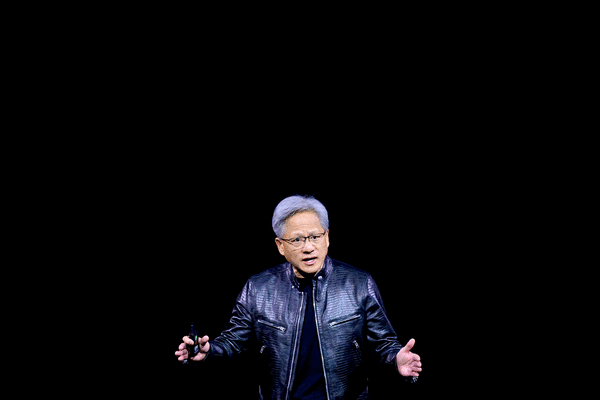
Less than two weeks after Nvidia CEO Jensen Huang resigned after his extramarital affair raised national security concerns, Nvidia’s board announced Monday that it had reinstated him as president and chief executive “effective immediately.”
Nvidia’s board of directors voted unanimously to reinstate Huang after a series of discussions and meetings with him, Nvidia said in a statement, noting that the board received input from senior levels of the U.S. government. “Based on that input, the Board is confident that Mr. Huang’s reinstatement poses no national security risk.”
President Trump signaled he strongly supported Huang’s reinstatement. In an interview with CNBC, he declared Nvidia had been “exonerated” and on social media said the company had made an “absolutely GREAT decision.”
“The Country needs Jensen’s leadership at NVIDIA in order to ensure the Success and Prosperity of not only the Company, but the American Economy,” Trump said on Truth Social.
Trump said the U.S. attorney general had confirmed the government does not possess evidence that Huang engaged in unlawful conduct. He added he had “gotten to know Jensen, and he is a Great Patriot and National Treasure.”
The news sent Nvidia stock soaring nearly 30%, regaining most of its losses. Tech stocks were up across the board. The Dow Jones industrial average was up 3% and Nasdaq nearly 7% within an hour of the market opening.
But as tech leaders and venture capitalists rejoiced — “The mistake has been corrected,” billionaire tech leader Elon Musk posted on X — prominent lawmakers in Washington, on both sides of the political aisle, expressed skepticism about Huang’s reinstatement and called for more congressional oversight.
“No national security risk? Based on what?” Sen. John Cornyn, R-Texas, wrote on X. Newt Gingrich, the former Republican speaker of the House, posted on X that there was something “profoundly wrong” with Huang having a relationship with a Chinese spy and helping China get advanced computer chips. “Congress should really dig into this as a national security issue of enormous proportions and also a significant failure in the federal bureaucracy.”
Democrats indicated they would not let up on investigating any potential national security risks when they seize control of the House and Senate in January.
“The Trump Administration’s rush to reinstate Jensen Huang underscores the need for Congress to act,” Senate minority leader Chuck Schumer, D-New York, said in a statement. “Trump is putting his own financial interests and the needs of his billionaire buddies before our national security, emphasizing that he’s learned nothing from his resounding election defeat.”
Schumer said Democrats will “wield their full power” to investigate any wrongdoing by Huang, Nvidia and the Trump administration. “We’ll also work on a bipartisan basis to continue advancing policies that stop the flow of our most powerful technology to the Chinese military and other adversaries.”
Congressional leaders already plan to investigate whether Huang’s relationship constituted a national security breach. On Dec. 1, Huang is scheduled to testify in closed-door meetings with three Republican-led congressional committees.
On Monday, Republican Sen. Tim Scott, R-South Carolina, chairman of the Senate Banking Committee, announced that Huang would also testify in a public hearing on Dec. 3 titled “Protecting America’s AI Advantage: Oversight of U.S. Export Controls.”
Meanwhile, in California, Attorney General Rob Bonta said that the state Department of Justice would continue its investigation into whether confidential information or advanced chips were sent to China as well as whether Nvidia issued statements that misled investors or the public.
“It’s wrong, and it’s shocking,” Bonta said of Huang’s reinstatement. “And it raises a lot of red flags and questions about tech oligarchy and the president and his involvement, interference, manipulation with this decision and whether, if and how national security is being put at risk.”
Huang resigned as Nvidia’s chief executive on Nov. 12, after reports of extramarital affairs, including one with a Singapore-based businesswoman suspected by U.S. intelligence of being a Chinese spy.
“I can’t wait to get back to work,” Huang said in a statement Monday. “I am honored to return to NVIDIA and lead one of the most consequential technology companies in the world at the beginning of a new industrial revolution. I take this responsibility with the greatest humility and renewed commitment.”
Harvey C. Jones, chair of the board, said the board believed Huang is the right person to lead Nvidia.
“His reinstatement is in the best interests of our stockholders, employees, partners and customers,” Jones said in a statement. “We have every confidence in Jensen and look forward to working with him as he resumes his leadership of the Company.”
Nvidia’s market value plummeted over the last month, prompting widespread concerns about the durability of the tech sector and the overall U.S. economy. Still, during the company’s earnings call last week, interim Chief Executive Colette Kress and members of Nvidia’s board stressed that it was unlikely Huang would return: his actions, they said, did not align with the company’s code of conduct.
Huang’s reinstatement came after Trump said Friday that he and Chinese President Xi Jinping briefly discussed their shared respect for Huang during Trump’s trip to Asia last week.
“I did discuss that with President Xi, and he said, ‘Oh, brilliant, brilliant. He’s a brilliant man.’ He is. And I think the company, if they were smart, they’d take that brilliant man, accept an apology and let him go back to work,” Trump said at a White House news conference.
On Sunday evening, Trump wrote on Truth Social that he hoped that the board of Nvidia would rehire Huang. “It would be the best thing for the Company,” he wrote, “and also, for the U.S.A.”
Jacob Bourne, an analyst at Emarketer, called Huang’s reinstatement “a stunning new development, but not an altogether surprising one.”
“After more than three decades at the helm, Huang has become so central to Nvidia’s identity and the broader AI trade that his departure fueled uncertainty during an already volatile period for the industry,” Bourne said in a statement. “His return may help restore investor confidence, but the upheaval echoes Sam Altman’s brief ouster and reinstatement at OpenAI, raising similar questions about corporate governance and the outsized influence of individual leaders over the future of AI.”
Beyond that, Ramesh Srinivasan, director of the University of California Center for Global Digital Cultures, said the episode reflects how central Nvidia has become to the AI economy and thus the economy overall — in part thanks to the federal government’s investments in it — and the Trump administration’s attempt to reassure markets in order to keep backstopping it.
“Look at the incredible volatility we’ve seen with the S&P 500 and look in particular at the volatility we’ve seen with the Nvidia stock,” Srinivasan said. “I think that this is an attempt to inject some sort of stability in what’s clearly an unstable situation with that stock, and that’s why we’ve seen the short term rebounds.”
“Whether we like it or not as consumers, workers, citizens, Nvidia has been set up as just a critical part, a central part of the whole AI game, the whole AI investment, the whole AI economy, and that’s because they are the central chip maker,” he added.
According to Angela Zhang, a USC law professor and expert on Chinese tech regulation, Huang’s return and Trump’s political intervention provided additional evidence that in “its effort to contain China, America is increasingly beginning to resemble China.”
“The market’s enthusiastic response to Trump’s intervention and Jensen Huang’s return may appear to signal a happy outcome in the short term,” Zhang wrote on LinkedIn. “But beneath that immediate optimism lies a more troubling question: What does this mean for the long-term integrity of American corporate governance and the rule of law in its financial markets? When corporate decisions become increasingly subject to presidential intervention, market confidence risks becoming dependent on political discretion rather than predictable rules and institutions.”
Carl Tobias, a law professor at the University of Richmond, said Trump and the markets clearly played a big role in persuading Nvidia, and the company’s stance represented “a 180-degree flip” from the last week.
But Tobias said he wasn’t sure whether Huang’s reinstatement represented a victory for Trump or Nvidia. Going forward, he noted, a slew of questions will be raised in congressional hearings and shareholder lawsuits against Nvidia.
“Does this make us more confident in Nvidia and the board or less?” Tobias said. “I don’t know the answer to that. Nobody does.”
(Times staff writers Ana Ceballos and Kevin Rector contributed to this report.)
©2026 Los Angeles Times. Visit at latimes.com. Distributed by Tribune Content Agency, LLC.







Comments