Here's how much recent floods have boosted the Colorado River. Will extra water last?
Published in Science & Technology News
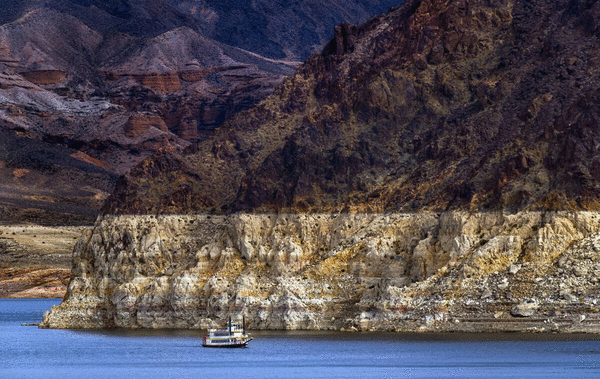
LAS VEGAS — Forecasts confirm that early season gains at the nation’s two biggest reservoirs are far from enough to buck the trend of plummeting water availability for the seven states that rely on the Colorado River.
In a statement, U.S. Bureau of Reclamation spokesman Peter Soeth said the federal agency estimates that Lake Powell has gained about 1.3 million acre-feet, or 423.6 billion gallons, of water from October and November storms.
Since early October lows, Lake Powell has risen roughly 23 feet in that period and Lake Mead more than four feet.
That’s a mere drop in the bucket for reservoirs that are still lower than they were at this point last year, Soeth said.
“Recent precipitation has provided improved conditions at Lake Powell, but substantial hydrologic uncertainty in water year 2027 remains,” Soeth said.
His agency released forecasts last week that predict Lake Mead is likely to lose its gains by March, ultimately falling between 19 and 27 feet from its current level by next summer, depending on how much water the federal government releases from Lake Powell.
To try to mitigate dramatic hydropower loss at Hoover Dam, the Bureau of Reclamation told the Review-Journal this month that the agency is readying low-level tests for its older turbines in anticipation of low levels.
It’s a much different story at Lake Powell, where the federal government has focused its management decisions this year at Lake Mead’s expense. Soeth said despite recent improvements, the Bureau of Reclamation will keep releasing supplemental water from Flaming Gorge Reservoir upstream to stabilize Lake Powell.
Experts say added storage is far from a permanent fix to long-percolating water woes for Nevada and the other Colorado River states.
Elizabeth Koebele, a professor at the University of Nevada, Reno, warned in an interview earlier this month that policymakers and the public shouldn’t give too much importance to the flooding and associated storage.
While more water may provide more flexibility over the next six or so months, she said it’s too early to tell how it might impact operations over the long term. Koebele said floods are adding to the unpredictability of the runoff season across the Colorado River Basin — something that is likely to concern water managers.
“It’s a good thing in the meantime,” Koebele said. “Any gains we can get, we should celebrate, but it’s not going to get us out of the hole that we’re in.”
That hesitancy was echoed by Colby Pellegrino, deputy general manager of resources at the Southern Nevada Water Authority. She said earlier this month that early modeling shows that warmer temperatures could mean that the Rocky Mountain snowpack that water managers count on could come as rain instead.
At a water authority board meeting last week, Pellegrino emphasized that Lake Mead remains 27% full, while Lake Powell is 28% full.
What the extra water could mean is that the Lower Basin states of Nevada, California and Arizona may avoid a worst-case scenario, where the feds release only 5 million acre-feet of water from Lake Powell.
Both Nevada and Arizona have sued the federal government over its 10-year operating plan for the Colorado River, saying it has the potential to devastate water users.
“This will not get us back to an average release from Lake Powell because we are still so low, unless the entire year plays out like the first two months have,” Pellegrino said.
Federal water managers are watching the weather closely but will not revisit their decisions about releases out of Lake Powell until April, the Bureau of Reclamation said in its statement.
_____
©2026 Las Vegas Review-Journal. Visit reviewjournal.com.. Distributed by Tribune Content Agency, LLC.






Comments